Technique · 8 min read ·
How to Make Chocolate Ganache: Ratios for Every Use
To make chocolate ganache, pour simmering heavy cream over chocolate, wait one minute, then stir from the center until glossy. The ratio by weight sets the texture: for 60 to 70% dark chocolate, use 1:1 for a glaze, 2:1 for truffles and 1:2 for a light whipped ganache. Milk chocolate needs more chocolate.
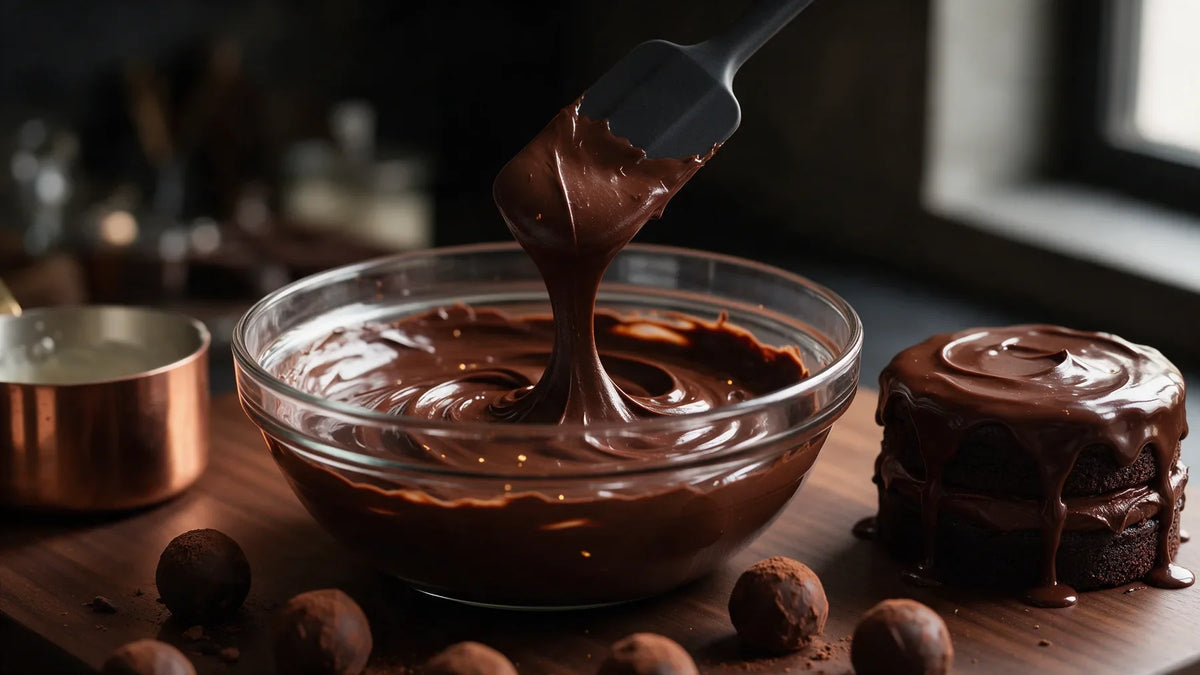
Chocolate ganache is an emulsion of chocolate and hot cream. Pour simmering heavy cream over chocolate, wait a minute, then stir from the center until the mixture turns glossy and smooth. The ratio of chocolate to cream, measured by weight, decides whether you get a pourable glaze, a spreadable frosting, a firm truffle center or a light whipped ganache.
Chocolate ganache ratio chart
The ratios below are chocolate to heavy cream by weight. Treat them as starting points: room temperature, cream fat and how you plan to use the ganache all shift the result. Make a small test batch, let it set, and adjust in small steps.
| Use | Dark Chocolate 60% or 70% | Dark Chocolate 55% | Dark Milk Chocolate 49% | Milk Chocolate 43% |
|---|---|---|---|---|
| Glaze or drip | 1 : 1 | 1.25 : 1 | 1.5 : 1 | 2 : 1 |
| Soft frosting or filling | 1.5 : 1 | 1.75 : 1 | 2 : 1 | 2.5 : 1 |
| Truffles and piped ganache | 2 : 1 | 2.25 : 1 | 2.5 : 1 | 3 : 1 |
| Whipped ganache | 1 : 2 | 1 : 1.75 | 1 : 1.5 | 1 : 1.25 |
How to read the chart: 1 : 1 means equal weights, for example 7 oz (200 g) chocolate and 7 oz (200 g) cream. 2 : 1 means twice as much chocolate as cream, for example 7 oz (200 g) chocolate and 3.5 oz (100 g) cream. In the whipped row the cream is the larger number.
How to make chocolate ganache, step by step
- Weigh the chocolate and the heavy cream on a kitchen scale. Ratios only work by weight; cup measures are not precise enough.
- Put the chocolate in a heatproof bowl. Franceschi chocolate comes in 4 g pieces that melt evenly, so there is nothing to chop. If you use a bar, chop it finely so it melts at one rate.
- Heat the cream in a saucepan until it just simmers, with small bubbles around the edge. Do not let it boil hard.
- Pour the hot cream over the chocolate, nudge any pieces under the surface and let it stand for 1 to 2 minutes.
- Stir with a spatula in small circles in the center of the bowl. A glossy, elastic core will form; widen the circles slowly until everything is pulled in. An immersion blender works even better: keep the head fully submerged and tilted so you do not whip in air.
- If a few pieces are still solid, set the bowl over barely simmering water for a few seconds at a time, stirring, until smooth.
- Use it or let it set. Pour glazes at about 90 to 95 °F (32 to 35 °C). For frosting, fillings and truffles, press plastic wrap onto the surface and leave the ganache at cool room temperature, around 64 to 68 °F (18 to 20 °C), for several hours or overnight. For whipped ganache, refrigerate it instead.
For a refresher on gentle melting, see our guide on how to melt chocolate chips.
Ganache for every use
Glaze and drip ganache
A 1 : 1 dark ganache poured at 90 to 95 °F (32 to 35 °C) gives a smooth, shiny coat over a chilled cake or tart. For drips, let it cool a little further, to roughly 85 to 90 °F (29 to 32 °C), and test one drip on the side of a cold cake before going all the way around: warmer ganache runs to the board, cooler ganache stops short. Dark Chocolate 70% has the highest fluidity in our range, which helps it lay down a thin, even glaze.
Ganache frosting and fillings
For a spreadable frosting or a tart filling, use more chocolate (1.5 : 1 with 60% or 70%) and let the ganache set at cool room temperature until it has the texture of soft peanut butter, then spread. For a cake that will be covered in fondant, a firmer 2 : 1 ganache holds sharper edges.
Truffles and piped ganache
Truffle centers need a ganache firm enough to pipe and roll: 2 : 1 for 60 to 70% dark, 3 : 1 for milk. Let it set overnight, pipe or scoop it, then roll the pieces in cocoa powder or dip them in tempered chocolate for a thin, crisp shell. Our guide on how to temper chocolate covers the dipping chocolate.
Whipped ganache and whipped ganache frosting
Whipped ganache is ganache made with extra cream, chilled and then whipped like cream. Make it at 1 : 2 with dark chocolate, cover it and refrigerate for at least 4 hours or overnight so the cocoa butter sets. Whip on medium speed only until it holds soft to medium peaks, then stop: overwhipped ganache turns grainy and dull. A common pastry technique is to heat only half the cream, emulsify the ganache with it, then stir in the remaining cold cream, which shortens the chilling time.
For a sturdier, fluffier whipped ganache frosting for cupcakes and layer cakes, let a 1 : 1 dark ganache cool to room temperature until thick but not set, then whip it for a few minutes until it lightens in color. The texture sits between a ganache and a mousse; for the real thing, try our dark chocolate mousse.
How cacao percentage changes the ganache ratio
Two things set a ganache: cocoa solids, which absorb water from the cream and thicken it, and cocoa butter, which crystallizes as it cools. A higher-percentage dark chocolate carries more of both and less sugar, so it sets firmer at the same ratio. That is why the chart asks for more chocolate as the percentage drops.
- Dark Chocolate 70% (41% fat) sets the firmest of our range and tastes the most intense. It handles the most cream.
- Dark Chocolate 60% (35% fat) has a thicker texture and a long finish. Use the same ratios as for 70% and expect a slightly softer set.
- Dark Chocolate 55% (35% fat) is sweeter and sets softer. If you swap it into a recipe written for 70%, start with about 10% more chocolate by weight and adjust after a test batch.
- Dark Milk Chocolate 49% (37.7% fat) has more cacao than a classic milk chocolate but still contains milk solids, so it needs more chocolate than any of the darks.
- Milk Chocolate 43% (37% fat) sets the softest. Milk fat is softer than cocoa butter, so milk chocolate ganache needs the highest proportion of chocolate to cream.
All five are made with Venezuelan cacao beans and crafted in Peru. If you are still choosing, our page on chocolate for ganache lays out the options.
Heavy cream for ganache: which one to buy
Use heavy cream, also sold as heavy whipping cream, which under the US standard for heavy cream contains at least 36% milk fat. It gives a stable emulsion and it is the only cream that whips reliably for whipped ganache. Light whipping cream, at 30 to 36% milk fat, works for a glaze but sets softer. Half-and-half, at 10.5 to 18% milk fat, carries too much water and too little fat for anything but a thin chocolate sauce.
A few optional additions change texture and flavor:
- Butter, stirred in once the ganache cools to about 95 °F (35 °C), adds softness and a rounder mouthfeel.
- Glucose syrup or invert sugar, a spoonful added with the cream, adds shine and keeps the texture smooth.
- Infusions such as vanilla bean, coffee beans, citrus zest or spices: steep them in the hot cream, strain, then top the cream back up to its original weight.
- Liqueur counts as liquid. Add it once the ganache is below about 95 °F (35 °C) and reduce the cream slightly.
Why ganache splits and how to fix it
A split, or broken, ganache looks greasy, with oil pooling on top and a grainy or curdled texture underneath. The emulsion has failed and the fat has separated from the water in the cream.
Common causes
- Too hot. Boiling cream or overheating the mixture pushes cocoa butter out of the emulsion.
- Too little liquid for the fat. Very high chocolate ratios or a lot of added butter leave too little water to hold the fat droplets.
- Temperature shock. Cold liqueur or cold cream added to warm ganache, or ganache stirred hard while it is setting.
- Stirring too fast, too early. Beating air into hot ganache instead of building the emulsion from the center.
How to fix a split ganache
- Bring the ganache to about 90 to 95 °F (32 to 35 °C), warming it gently over a water bath or letting it cool, depending on where it is.
- Add 1 tablespoon of warm milk. Milk carries more water and less fat than cream, which is exactly what a split ganache is missing.
- Blend with an immersion blender, head submerged, or stir hard from the center with a spatula until the gloss returns.
- Still broken? Add another tablespoon of warm milk and blend again. Stop as soon as it comes back together.
Ganache made with fresh cream keeps, covered, in the refrigerator for about a week. Bring it back to working temperature slowly over a water bath and stir it smooth before using.
The surest way to find your ganache chocolate is to make the same recipe with two different chocolates and taste them side by side. The Discovery Kit gives you four Franceschi products, 4.23 oz (120 g) each, so you can run that test in your own kitchen before choosing a 2 lb bag.
Frequently asked questions
What is the ratio for chocolate ganache?
Ganache ratios are chocolate to cream by weight. For dark chocolate between 60 and 70%, a 1:1 ratio makes a pourable glaze, 1.5:1 a soft frosting, 2:1 a firm truffle ganache, and about 1:2 a whipped ganache. Lower-percentage dark and milk chocolates set softer, so they need noticeably more chocolate for the same texture.
Can you make ganache with milk instead of heavy cream?
You can, but expect a thinner, softer ganache that will not whip. Whole milk has far less fat and more water than heavy cream, so you need more chocolate than you would with cream, and the result is best for sauces, glazes and drinks. For frostings, truffles and whipped ganache, heavy cream is the reliable choice.
How long does ganache take to set?
At cool room temperature, around 64 to 68 °F (18 to 20 °C), a frosting or truffle ganache usually needs 4 to 8 hours, and overnight is safest for firm truffle centers. A glaze sets on a chilled cake in roughly 20 to 30 minutes. Whipped ganache needs at least 4 hours in the refrigerator before you whip it.
Why is my ganache grainy?
Grainy ganache usually means the emulsion broke from overheating, the ganache was worked too hard as it cooled, or whipped ganache was whipped too long. Warm it gently to about 90 to 95 °F (32 to 35 °C), add a tablespoon of warm milk and blend until glossy. For overwhipped ganache, melt it, chill it again and rewhip.
Can you whip any ganache?
Only ganache with enough cream whips into a light texture. A 1:2 dark chocolate ganache chilled for at least 4 hours whips into soft, airy peaks. A firmer 1:1 ganache, cooled to room temperature, whips into a denser frosting. Ganache made with milk instead of cream, or a very firm truffle ganache, will not whip well.
How do you make ganache icing thicker?
Let it cool longer, because ganache thickens as the cocoa butter crystallizes. If it is still too thin once fully set, the ratio is too low: warm it gently, stir in more chocolate a little at a time and test again. For a thinner, more pourable icing, warm it slightly or add a spoonful of warm cream.